The rapid expansion of artificial intelligence is creating demand for massive data centers across the United States. These facilities require enormous amounts of electricity and sophisticated cooling systems to prevent increasingly powerful computer equipment from overheating.
Much of the environmental debate surrounding data centers has focused on their electricity and water consumption. But another concern is beginning to emerge: the potential use of PFAS chemicals in advanced cooling technologies.
A recent Fortune report highlighted research suggesting that growing demand from AI infrastructure, semiconductor manufacturing, and other high-tech industries is contributing to increased PFAS production. Some fluorinated chemicals are particularly attractive for advanced cooling applications because they are extremely resistant to heat and chemical degradation.
Those same properties, however, are part of what has made PFAS contamination such a significant environmental problem.
As data centers expand throughout the country, the question may no longer be limited to how much water or electricity these facilities consume. Communities, regulators, property owners, and attorneys may increasingly ask another question:
What happens if the chemicals used to support the AI boom escape into the environment?
Why Would Data Centers Use PFAS?
Modern AI hardware generates tremendous amounts of heat.
Traditional data centers have generally relied on air cooling and water-based cooling systems. As computing density increases, however, operators have explored more advanced forms of liquid cooling.
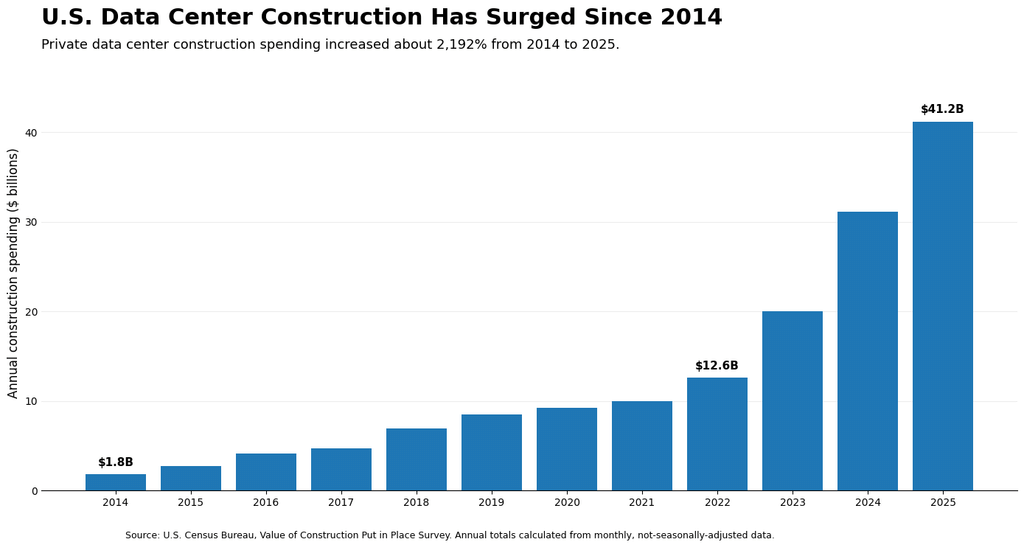
The scale of that expansion is significant. U.S. Census Bureau construction data show that annual private data center construction spending grew from approximately $1.8 billion in 2014 to more than $41 billion in 2025. As billions of dollars continue flowing into new data center infrastructure, the environmental implications of the technologies used to operate these facilities become increasingly important.
One technology is two-phase immersion cooling. Computer components can essentially be submerged in a dielectric fluid capable of absorbing large amounts of heat without damaging the electronics.
Certain fluorinated chemicals have properties that make them attractive for these systems.
But the industry does not necessarily need PFAS-based cooling. PFAS-free single-phase liquid cooling technologies are also being developed and deployed, making the decisions being made today particularly important.
Data centers constructed during the current AI expansion could operate for decades. The cooling technologies selected now could therefore influence potential environmental risks far into the future.
The Concern Is Not Necessarily Normal Operation
Companies developing fluorinated cooling products have emphasized that these systems can operate as closed loops.
That distinction matters. The presence of PFAS at a facility does not automatically mean surrounding groundwater or drinking water will become contaminated.
The larger environmental question is what happens throughout the chemical’s entire lifecycle.
Potential releases could occur through:
- Manufacturing of the cooling chemicals
- Transportation and storage
- Equipment leaks or failures
- Maintenance operations
- Accidental spills
- Air emissions
- Disposal of used cooling fluids
- Disposal or recycling of contaminated equipment
A chemical may remain contained during normal operation while still creating environmental risks elsewhere in its lifecycle.
And with PFAS, even relatively small releases can become significant because many compounds in this chemical family are extraordinarily persistent.
Environmental Groups Are Already Challenging New Data Center Cooling Chemicals
This issue is not merely theoretical.
In July 2026, a coalition of 17 environmental organizations urged the U.S. Environmental Protection Agency to reject a proposed PFAS chemical known as Opteon 2P50 that is intended for use in data-center cooling applications.
The groups raised concerns about potential releases from large-scale cooling systems and questioned whether available toxicological information was sufficient to determine the chemical’s risks.
The dispute illustrates a regulatory challenge that is likely to become increasingly important.
Artificial intelligence infrastructure is expanding faster than scientists and regulators can fully evaluate every chemical and technology being introduced to support it.
That creates the possibility that widespread deployment could occur before the environmental consequences are completely understood.
PFAS Litigation Shows What Can Happen When Contamination Is Discovered Years Later
PFAS litigation already provides a warning about how environmental liabilities can develop.
For decades, PFAS compounds were incorporated into industrial processes and products because of their resistance to heat, water, grease, and chemical degradation.
Only later did widespread contamination become a major environmental and public-health concern.
Communities across the United States have since confronted PFAS contamination in drinking water, groundwater, soil, and other environmental media. Litigation involving manufacturers and other potentially responsible parties has resulted in billions of dollars in settlements and remediation commitments.
Data-center cooling fluids are not the same products involved in many of those historical cases.
But the broader lesson is relevant.
The environmental consequences of persistent chemicals may not become apparent until years after their use becomes widespread.
Data Centers Could Create Complicated Questions About Responsibility
If PFAS associated with a data center were eventually discovered in groundwater or drinking water, identifying the responsible parties could become complicated.
Depending on the circumstances, potential investigations could involve chemical manufacturers, cooling-system manufacturers, data-center operators, property owners, waste-management companies, contractors, and other entities involved in handling or disposing of the chemicals.
Determining responsibility could require reconstructing years of chemical purchasing records, waste manifests, facility operations, groundwater movement, and historical releases.
Those questions become even more complicated when contamination migrates beyond the property where the original release occurred.
Groundwater does not follow property boundaries.
A release at one industrial site can potentially affect neighboring properties or drinking-water sources some distance away.
Federal PFAS Law Is Already Creating Significant Cleanup Liability
The legal environment surrounding PFAS has also changed considerably.
The EPA designated PFOA and PFOS as hazardous substances under the Comprehensive Environmental Response, Compensation, and Liability Act, commonly known as CERCLA or Superfund.
That designation gives federal authorities additional tools to investigate contamination and seek cleanup costs from parties responsible for certain releases.
In August 2026, the U.S. Court of Appeals for the D.C. Circuit upheld EPA’s designation of PFOA and PFOS as CERCLA hazardous substances.
Not every PFAS chemical currently receives identical treatment under federal law. Newer fluorinated cooling compounds may also differ chemically and legally from PFOA and PFOS.
But PFAS regulation has consistently moved toward greater scrutiny, disclosure, and accountability.
Companies making long-term infrastructure decisions today therefore have to consider not only current regulations, but what environmental regulation could look like ten or twenty years from now.
Drinking Water Standards Add Another Layer of Potential Costs
PFAS contamination also creates potential downstream costs for drinking-water providers.
Federal drinking-water standards currently establish maximum contaminant levels of 4 parts per trillion for PFOA and PFOS.
EPA proposed in 2026 to preserve those limits while potentially allowing qualifying water systems additional time, through 2031, to achieve compliance.
Those extraordinarily low concentrations illustrate one of the defining challenges of PFAS contamination.
A release does not necessarily have to involve enormous quantities before investigation and treatment become expensive.
Once contamination reaches a drinking-water source, utilities may have to conduct additional testing, install treatment systems, locate alternative water supplies, or undertake other mitigation measures.
Those expenses can eventually become central issues in environmental litigation.
Today’s AI Infrastructure Decisions Could Become Tomorrow’s Environmental Cases
The AI industry is developing at extraordinary speed.
Data centers are being planned and constructed across the country as companies race to secure the computing capacity necessary for increasingly sophisticated artificial intelligence systems.
That growth can provide jobs, tax revenue, technological development, and economic investment.
But rapid industrial expansion has historically created problems when environmental risks are treated as secondary concerns.
PFAS contamination presents a particularly important lesson because these chemicals can remain in the environment for extremely long periods of time.
Infrastructure built today may eventually be replaced.
Servers will become obsolete.
Cooling systems will be upgraded.
Companies may merge, sell facilities, or disappear entirely.
Persistent chemical contamination can remain.
Preventing PFAS Contamination Is Easier Than Cleaning It Up
The emerging debate over PFAS-based data-center cooling provides an opportunity to address environmental risks before widespread contamination occurs.
Data-center developers, chemical manufacturers, regulators, and communities can evaluate PFAS-free alternatives, establish monitoring requirements, document chemical usage, develop spill-response procedures, and plan for the eventual disposal of cooling fluids and equipment.
Those precautions may appear expensive during construction.
The history of PFAS contamination suggests that remediation can be far more expensive.
For communities located near rapidly expanding data-center developments, understanding which chemicals are being used and how they are managed may become an increasingly important part of protecting local drinking water and groundwater resources.
To learn more about PFAS and ongoing PFAS litigation visit our sister-site Cleangroundwater.com.
Stag Liuzza represents individuals, communities, and public entities confronting the consequences of PFAS and other forms of environmental contamination. As new industries create new pathways for persistent chemicals to enter the environment, determining who knew about those risks, when they knew about them, and who should pay for the resulting damage will remain central questions in environmental law.
If you are a private property owner or represent a municipality affected by PFAS contamination, contact Stag Liuzza today for a free consultation to discuss your potential case..